The Red Pen Problem: How Small Cultural Misunderstandings Can Quietly Damage Global Teams
Sometimes the problem isn’t what was said. It’s what the other person thought it meant.
Imagine This
You’re rushing out the door.
You need to leave a quick note for your colleague, Ade, who happens to be Nigerian. You grab the first pen you see, scribble the message and leave because you need to get your child to soccer practice.
The next day, your supervisor asks to speak with you. Ade thinks you are upset with him and you don’t understand why.
You weren’t angry.
You weren’t trying to be rude.
You weren’t sending a hidden message.
You were simply in a hurry.
Suddenly, a simple handwritten note has become a workplace issue. What happened?
The Issue Was Not the Message. It Was the Red Pen!
For many Nigerians, red can carry a threatening or negative meaning. In some cultures, it may even symbolize danger or evil. So, while you saw a harmless note, Ade experienced something very different.
That is the reality of working across cultures. Your intention and someone else’s interpretation do not always match.
And if you lead a global or culturally diverse team, you have probably seen this play out in your own workplace:
When someone stayed quiet in a meeting and others assumed they had nothing to contribute.
When a team member avoided direct disagreement because, in their culture, challenging a senior leader openly feels disrespectful.
These moments can feel small at first, but they rarely stay small.
Over time, cross-cultural misunderstandings can slow down projects, create unnecessary conflict, damage trust, and leave people feeling anxious about saying or doing the wrong thing.
Culture Is Always in the Room
One of the biggest mistakes I see in global workplaces is the assumption that culture only matters during holidays, celebrations, or diversity training sessions.
But culture is not something people leave at home.
Culture shapes how we think, speak, listen, decide, disagree, give feedback, receive feedback, build trust, respond to authority, and interpret respect.
Often, culture is working below the surface. That is why Edward T. Hall’s iceberg metaphor is so useful.
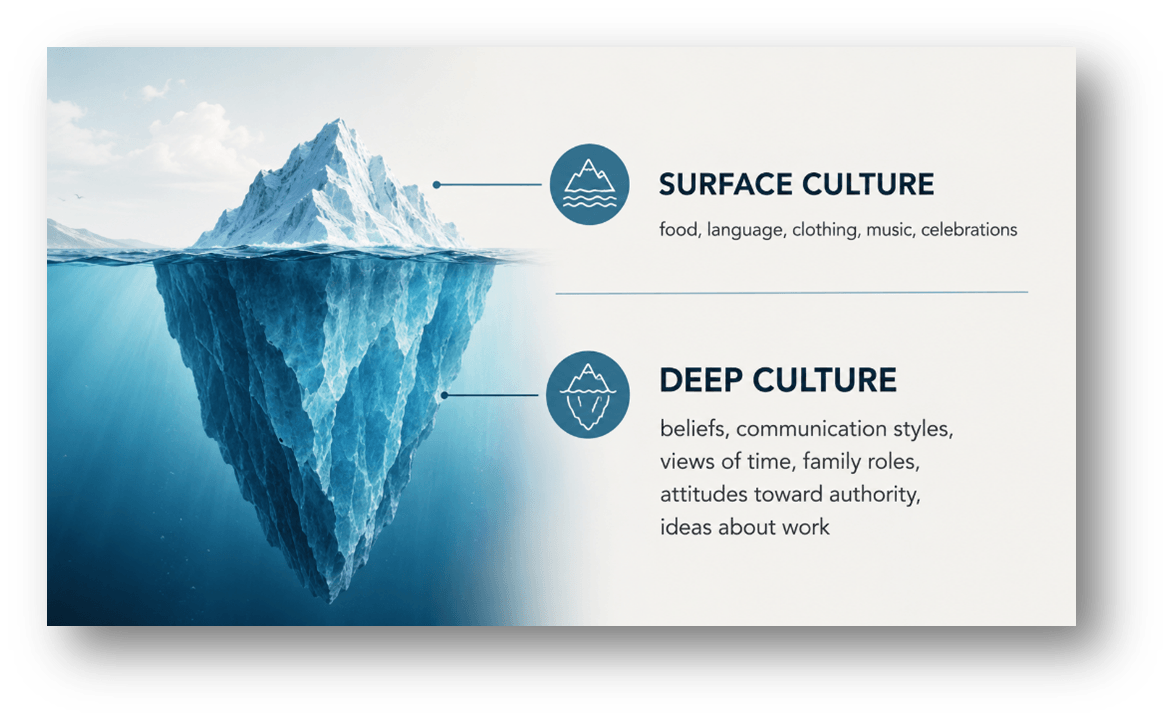
With an iceberg, you can see the part above the water. But most of it is hidden below the surface.
Culture works the same way. The visible parts are easy to notice: language, food, music, clothing, traditions, holidays. Those are the parts people often associate with cultural difference.
But the more powerful parts are usually hidden.
Things like: how people view time, how they communicate disagreement, how they view authority, how they interpret silence, and many other aspects.
These are the things that quietly drive workplace behavior. And when leaders do not understand that, they may misread what is really happening. For example, a quiet employee may be labeled disengaged, a direct communicator may be labeled rude, or a person who does not challenge ideas publicly may be labeled lacking initiative.
Three Things Global Leaders Need to Keep in Mind
If you lead a culturally diverse team, cultural competence is not a “nice to have.” It is a leadership skill. It is also a business skill. Below are three practical reminders that can help.
1. Remember the Iceberg
In culturally diverse workplaces, the potential for misunderstanding is high because there may be cultural factors you cannot immediately see.
So before you judge behavior, pause, and ask yourself: “What might be beneath the surface here?”
Maybe the person is not avoiding responsibility; they are uncomfortable saying no directly.
Maybe they are not disengaged but listening respectfully.
Maybe they are not being disrespectful. Their communication style is more direct than what others are used to.
The goal is not to memorize every cultural rule. That would be impossible! The goal is to become curious enough to stop assuming your interpretation is the only interpretation.
This one habit can prevent a lot of unnecessary conflict.
2. Do Not Interpret Everything Through Your Own Cultural Lens
This is one of the most important shifts a leader can make.
We all see behavior through our own cultural lens, and we all have ideas about what is normal, respectful, efficient, professional, or appropriate. Remember that those ideas are not universal.
If you interpret every behavior through your own lens, you may completely miss what the other person intended.
For example, in some cultures, speaking up quickly shows confidence. In others, pausing before speaking shows thoughtfulness.
In some cultures, challenging a leader’s idea is viewed as engagement. In others, it may be seen as inappropriate or disrespectful.
In some cultures, feedback is expected to be direct. In others, feedback is softened to preserve dignity and relationship.
A culturally competent leader learns to ask better questions before drawing conclusions.
Not “Why are they like this?”
But “What might this mean from their perspective?”
This question creates room for understanding. And understanding creates room for better leadership.
3. Stop Pretending Differences Do Not Matter
A lot of leaders try to be inclusive by saying, “I treat everyone the same.”
The intention is good, but in a global workplace, treating everyone the same does not always create fairness. That is because people do not all experience communication, authority, conflict, feedback, or belonging in the same way.
So, when leaders ignore cultural differences, they may unintentionally create more discomfort, not less.
A culture-blind approach is no longer enough. Cultural differences matter.
They matter in meetings.
They matter in feedback conversations.
They matter in client relationships.
They matter in performance discussions.
They matter when teams are under pressure.
They matter when deadlines are tight and people are stressed.
Ignoring those differences does not make them disappear. It just pushes them below the surface, where they can quietly become resentment, confusion, disengagement, or conflict.
The better approach is to create a team environment where people can talk about differences respectfully and practically.
Not in a way that stereotypes people. Not in a way that puts anyone on the spot. But in a way that helps the team work better together.
Final Thoughts
The red pen story may seem simple, but it reveals something every global leader needs to remember:
In culturally diverse teams, misunderstandings often happen in the space between what one person intends and what another person interprets.
That space can quietly shape everything — trust, feedback, collaboration, decision-making, client relationships, and team performance. And as a leader, you have the opportunity to close that gap.
Not by knowing everything about every culture. But by becoming more curious, more intentional, and more skilled at helping people understand one another.
So here is the question worth sitting with: Where might cultural differences be quietly slowing your team down right now?
Is it showing up in feedback conversations? Meetings? Decision-making? Conflict? Client communication? Project timelines? Team trust?
What you see on the surface may only be 10% of the issue. The real work — and the real opportunity — is often below the waterline.
When leaders learn to recognize what is beneath the surface, they do more than prevent misunderstandings. They create workplaces where people feel respected, included, and able to do their best work across cultures.
Ready to Go Deeper?
For more practical strategies to reduce misunderstandings, strengthen trust, and lead global teams with greater confidence, get your copy of Mastering Cultural Differences: Strategies for Leading a Global Workforce.
Inside, you’ll find actionable guidance to help you understand hidden cultural dynamics and build a workplace where diverse teams collaborate with clarity, respect, and purpose.
👉Get your copy today and start leading your global workforce with greater confidence.
Subscribe to The DEI+ Spotlight!
Sign up to get weekly tips and strategies about diversity, equity, and inclusion to help you increase your DEI IQ. Emails are guaranteed short and to the point!

© 2026 MASTERING CULTURAL DIFFERENCES.